

BarMar: Hydrogen interconnection between the Iberian Peninsula and Central Europe
PCI project 9.1.4. Hydrogen Interconnector Spain-France



The project
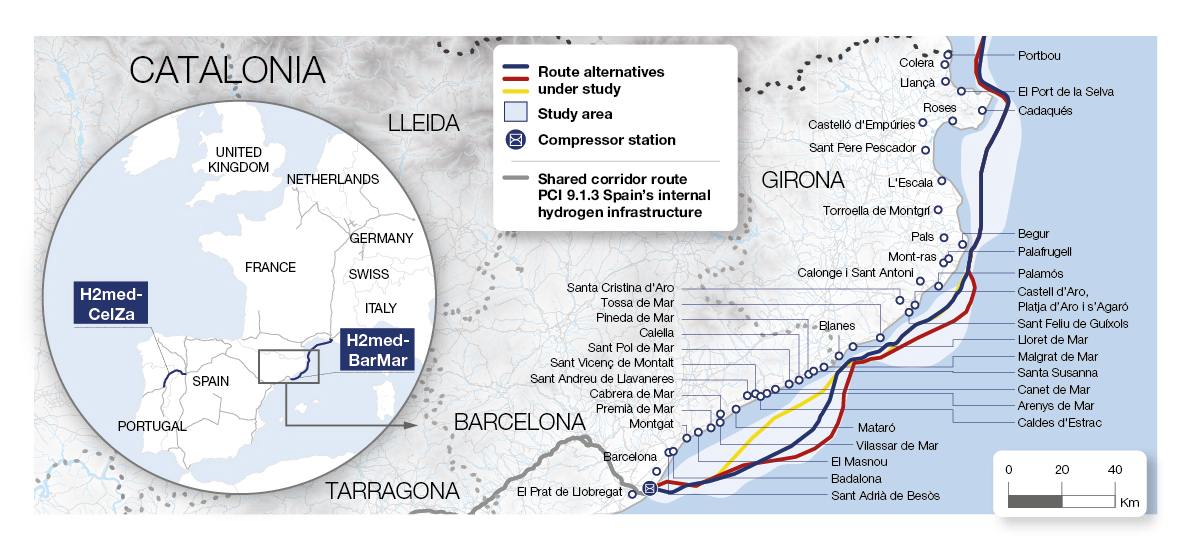
The BarMar project (PCI 9.1.4.) is a cross-border connection that will transport green hydrogen between Spain and France via an offshore pipeline. It will connect Barcelona with the industrial hub at Fos-sur-Mer, near Marseille, while also integrating Spain’s internal renewable hydrogen infrastructure (PCI 9.1.3) with France’s domestic infrastructure.
BarMar, together with CelZa, which will connect Portugal and Spain, forms part of the H2med project, a key corridor for exporting renewable hydrogen produced in the Iberian Peninsula to northeastern Europe.
Enagás, NaTran and Teréga are the promoters of the BarMar project, which will compromise approximately 400 kilometres of offshore pipeline and will have the capacity to transport 2 million tonnes of green hydrogen per year. The project, which includes a compressor station at the Port of Barcelona, is expected to come into operation in 2032 and will contribute to the European Union’s goal of becoming the world’s first climate-neutral continent by 2050.
An essential project for Europe
Green hydrogen is a key element in speeding up the energy transition towards net-zero emissions. An essential energy carrier for achieving the decarbonisation, security of supply and energy sovereignty targets defined by the European Union in its REPowerEU plan, and by the Spanish Government in its National Energy and Climate Plan (PNIEC).
BarMar will make it possible to export up to 2 million tonnes of renewable hydrogen per year from the Iberian Peninsula to France, which, in turn, will be connected to the hydrogen infrastructure of Germany and northwestern Europe to boost the decarbonisation of European industry and contribute to achieving the goals of the European Green Deal and REPowerEU.
The hydrogen economy in Spain will generate more than €32 billion in GDP and sustain around 81,000 jobs each year throughout its development*.
*Source: “Socio-economic impact of the development of the hydrogen economy in Spain”, a report issued by PwC for Enagás (2023).
≈400
KM
≈190
KM in cataluña
2
Mt/year
(maximum capacity)
1
COMPRESSOR STATION
(≈60 MW)
28,3 M€
CEF FUNDING
European financing for BarMar
As part of H2med, BarMar was designated by the European Commission as a Project of Common Interest (PCI) in the first call for hydrogen projects in April 2024.
In January 2025, the European Climate, Infrastructure and Environment Executive Agency (CINEA) awarded 100% of the requested Connecting Europe Facility (CEF Energy) funding for the project study phases of BarMar.
You can access the European Union Transparency Platform here.
An opportunity for Spain and France

Growth and competitiveness
≈€2.1 billion investment

A more sustainable energy future
A hydrogen network is key to decarbonising industry and heavy transport

Technological and industrial development
Creation of a hydrogen industry and generation of an innovative business fabric

Regional job creation and revitalisation
New jobs during the construction of BarMar and during operation and maintenance
What is green hydrogen and why is it important?
Green hydrogen is a versatile and clean energy carrier that does not generate polluting emissions, as it is produced from renewable energy sources through a water electrolysis process. It is therefore a key solution for decarbonising many strategic sectors of the economy, particularly those where electrification is not a viable option, such as heavy transport, the chemical industry, refineries and fertiliser production.
Green hydrogen is a key element in speeding up the energy transition towards net-zero emissions. An essential energy carrier for achieving the decarbonisation, security of supply and energy sovereignty targets defined by the European Union in its REPowerEU plan, and by the Spanish Government in its National Energy and Climate Plan (PNIEC).
What is the BarMar project?
BarMar is an offshore pipeline designed to transport renewable hydrogen between Spain (Barcelona) and France (Marseille). It forms part of the European H2med corridor, a strategic infrastructure project included in the European Union’s list of Projects of Common Interest (PCIs).
The project aims to connect the areas with the highest renewable hydrogen production potential in the Iberian Peninsula with Europe’s main industrial hubs, supporting the decarbonisation of key sectors, strengthening energy security and autonomy, and contributing to the development of an integrated European hydrogen market.
Why is the BarMar interconnection necessary?
Because it will enable renewable hydrogen to be delivered where it is needed to decarbonise European industry.
At the end of 2024, H2med carried out a non-binding market consultation process (Call For Interest) to identify hydrogen production and consumption needs along the corridor. The results confirmed the need for a hydrogen infrastructure network connecting supply from the Iberian Peninsula with consumption centres in northwestern Europe.
A pipeline network is the most efficient way to transport green hydrogen and make it accessible to multiple consumers, contributing to Europe’s energy sovereignty and competitive decarbonisation.
The BarMar interconnection will enable the export of up to 2 Mt/year of renewable hydrogen from Spain to the rest of Europe.
Where will the hydrogen transported by BarMar be consumed?
Renewable hydrogen produced in Spain will primarily be used to meet the needs of domestic industry through the future Spanish hydrogen backbone network.
In addition, part of this production will be exported to Europe through the H2med corridor, of which BarMar forms part. This infrastructure will enable green hydrogen to be transported to France and from there to other European industrial markets, contributing to the decarbonisation of continental industry and the development of an integrated European hydrogen market.
What specific infrastructure is planned for the BarMar interconnection?
The BarMar interconnection will consist of an approximately 400 km offshore pipeline dedicated exclusively to the transport of renewable hydrogen; a compressor station located at Enagás facilities in the Port of Barcelona; and a receiving station located south of the central mineral terminal in Fos-sur-Mer, near Marseille, France.
The pipeline will be made up of 12-metre-long pipes, with nearly 33,000 pipes in total, laid mostly at depths of between 50 and 120 metres.
What is the planned timeline for the BarMar project and what stage is it currently at?
The BarMar project is currently in the technical studies, environmental assessment and public consultation phase, in accordance with the requirements established for European Union Projects of Common Interest (PCIs).
Between 2025 and 2026, the development of basic and detailed engineering, environmental studies and administrative permitting processes is planned. Spain and France have already launched the implementation of the Conceptual Public Participation Plan (PCPP) in the territories involved in the project, with completion expected by July 2026.
Construction of BarMar is scheduled to take place between 2029 and 2032, with the infrastructure expected to enter into operation in 2032.
What impact will BarMar have on the local economy and employment?
The development of BarMar will contribute positively to local and regional economies by boosting industrial activity, technological innovation and investment.
During the construction phase, direct and indirect employment is expected to be created, particularly in sectors such as engineering, civil works, logistics and support services. During the operation and maintenance phase, the project will generate stable, skilled employment, reinforcing the role of the regions involved in the emerging renewable hydrogen economy.
More broadly, Spain’s hydrogen economy is expected to generate more than €32 billion in GDP and sustain around 81,000 jobs each year throughout its development, according to the report “Socio-economic impact of the development of the hydrogen economy in Spain”, issued by PwC for Enagás.
What impact will the project have on the environment?
The BarMar project has been designed to minimise environmental impact and contribute significantly to the fight against climate change.
Environmental protection has been a priority since the earliest stages of the project. Potential effects on the marine environment are being analysed in detail throughout the project’s development, with the aim of avoiding the most sensitive areas and implementing preventive and corrective measures wherever necessary.
Most potential impacts are associated with the construction phase and are temporary and localised. Once operational, the infrastructure will not generate direct emissions and will help avoid millions of tonnes of CO₂ emissions by enabling the use of renewable hydrogen in industrial sectors that are difficult to decarbonise.
Public consultation
As a PCI project, and in compliance with the provisions of the TEN-E Regulation of the European Union (EU Regulation 2022/869), the project developer in each region is obliged to implement a public participation plan to provide information and involve the citizens and stakeholders in the decision making with regard to a PCI in the field of energy.
On the first of April 2026, the National Commission for Public Debate (CNDP) validated the consultation concept proposed by BarMar and appointed three guarantors to oversee the process in France. For more information, see the project sheet on the CNDP website.
In Spain, Enagás has initiated the formal permitting process for the authorizations applicable to this PCI, in accordance with Regulation (EU) 2022/869 and the Authorization Procedure Manual for Energy PCIs, published by the Ministry for the Ecological Transition and the Demographic Challenge in October 2023. The public consultation process in Spain took place between May and July 2026.
What are the objectives?
- Shed light on BarMar’s approach by taking into account environmental sensitivity and social legitimacy from an early stage.
- Involve the community and encourage their active participation in the process.
- Identify and mitigate impacts in advance and ensuring the most appropriate actions are taken to address them.
- Resolving doubts and explaining the project.
- Be transparent in disclosing information about the future hydrogen network to all interested parties.
What does it involve?
These are some of the key information and engagement initiatives that Enagás will be carrying out as part of this process:

Website

Information leaflet
View in here.

Public engagement meetings with citizens and the local authority

Dissemination via information points (fixed and mobile)

Conferences with experts

Communications
Stay up to date with the latest project developments and the public consultation process.
Contact

Published 06/05/2026
Last update 23/07/2026